Destockd hands public domain footage back to the public
41,000+ free shots from U.S. government films, searchable by describing what you see.
Destockd is a free archive of more than 41,000 public domain and unrestricted shots from U.S. government films in the FedFlix archive. Instead of keywords, it uses CLIP-powered visual search, so you describe what you want to see. It was built by YouTuber Elroddd, who launched it in September 2026.
Here's a thing that happens more than it should. You find a great bit of old archival footage, the kind of grainy mid-century clip that would be perfect in a title sequence or a moodboard. You click through to license it and there's a watermark across the middle and a price tag that looks like a typo.
Then you find out the footage is public domain. It was made by the U.S. government, paid for with tax money, and legally belongs to everyone. Someone has just put it behind a checkout page.
Destockd is one person's answer to that.
What it is
It's a free, searchable archive of more than 41,000 shots taken from U.S. government films in the FedFlix archive, all of it public domain or unrestricted. No watermarks, no pricing tiers. You find a shot you like and you use it.
It was built by a YouTuber called Elroddd, who launched it this month with a video essay called "I Killed A Business Model." His argument is simple. This footage was made with public money or donated in good faith, and "institutions are gatekeeping public domain media" by making it hard to find or charging for it anyway. So he built the thing he wanted to exist.
It's worth watching the video. It's short, a bit chaotic in a good way, and the case he makes is pretty hard to argue with.
The search is the clever bit
Most footage libraries rely on keywords, which means you're at the mercy of whoever tagged the clips. If nobody thought to write "man looking through binoculars," you're never finding that shot.
Destockd skips all that. It uses a CLIP-powered visual search, so you describe what you want to see and it looks at the actual frames. Type "crowd waving flags" or "plane over mountains" or "hands typing" and it finds shots that look like that, whether or not anyone ever labeled them.
For archive footage, where the original catalog descriptions are usually a single dry sentence about the whole film, this makes a massive difference. It turns a pile of old reels into something you can actually search.
Ways in
If you don't know what you're after yet, there are three other ways in besides search:
- Collections gathers shots into curated sets, a good place to start if you just want to see what's there.
- Random serves up shots at random, which is dangerously good for procrastination and surprisingly good for inspiration.
- Films lets you browse the source films themselves, handy when you find one great clip and want to see where it came from.
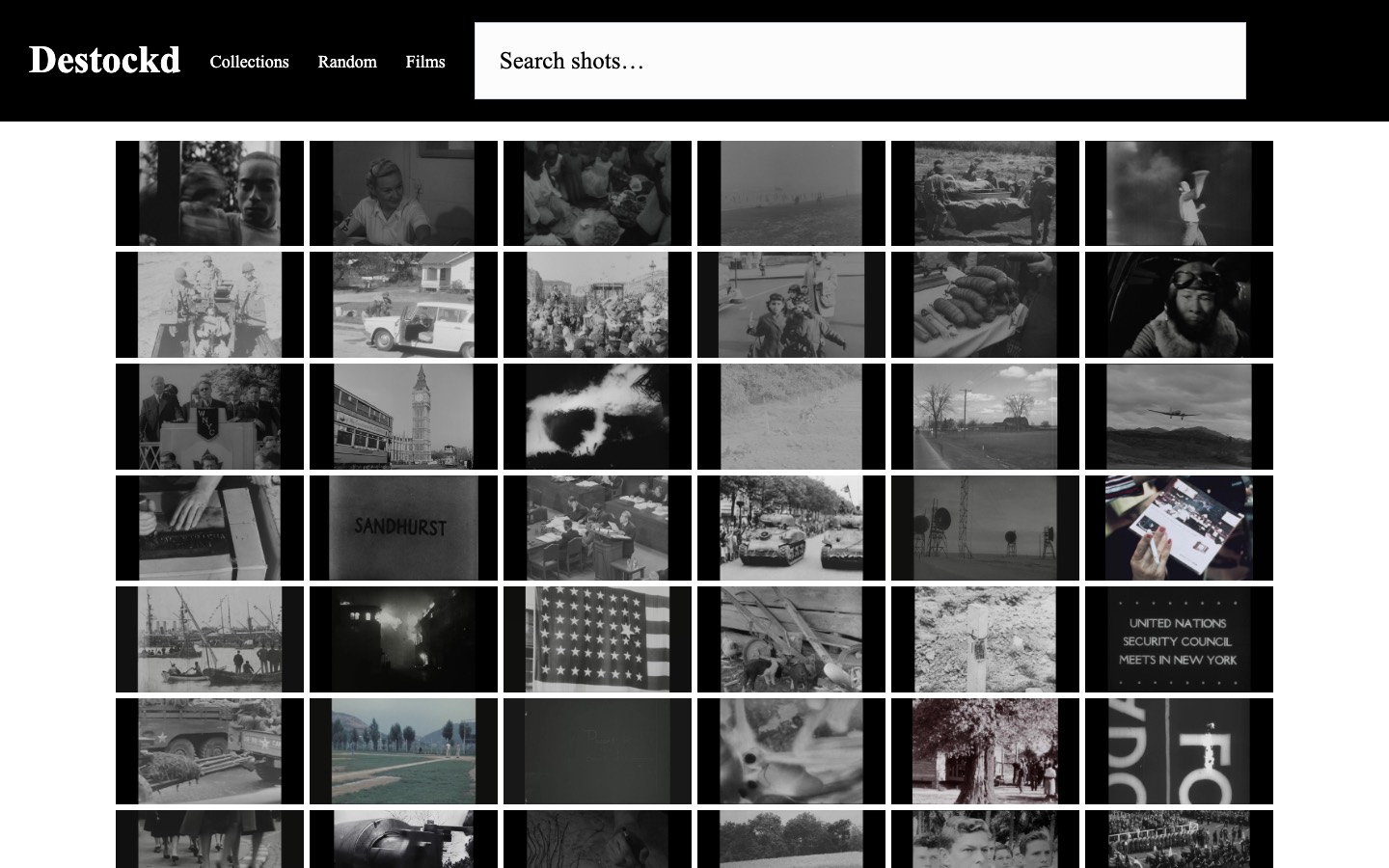
The site itself is refreshingly bare. Black header, search bar, a grid of stills. It's there to get you to the footage, not to sell you anything.
What it's good for
Title sequences and brand films that want some texture. Music videos. Pitch decks and moodboards where you need a feeling fast. Documentary and essay-style video, obviously. Collage and editorial design, if you're pulling stills. Anything that suits that slightly uncanny government-film look, which, it turns out, is a lot of things.
Heads up
It's a slice of the public domain, not all of it. By his own account it covers a small fraction of the footage that's out there, and it's all from U.S. government films, so the look and subject matter lean heavily towards mid-century America. Military, industry, civic life, a lot of men in hats. If you need footage of anything outside that world, you'll still be hunting elsewhere.
The site also asks you to check the rights information before using anything. Public domain footage can still include things like music, trademarks or recognizable people that come with their own rules, so it's worth a quick look before a clip goes into commercial work.
Who it's for
Video editors and motion designers who need archival texture without the licensing headache. Filmmakers on a budget. Designers making moodboards. Anyone who's ever paid for public domain footage and felt a bit silly about it afterwards.
Open it up, type in the strangest thing you can think of and see what comes back. There's a decent chance a government film from 1952 has you covered.
Written by Steve Salgado
About Destockd
- Made by
- Elroddd
- Library
- 41,000+ shots
- Source
- FedFlix, U.S. government films
- License
- Public domain / unrestricted
- Price
- Free
You might also like
Type drawn by people who design identities for a living
[ Read ↗ ]
Typewolf is how you stop using the same three fonts
[ Read ↗ ]