The joy of a dead end
Every pitch has an idea that doesn’t make it. It’s still working for you, if you kept it.

The ideas that get cut from a pitch are rarely wasted. Chasing them builds the instinct experienced creatives rely on, and some come back later when the timing is right. Keep killed concepts, review them after a lost pitch, and leave a dead end on purpose with what it taught you.
The idea you killed last month is still working for you. You just stopped paying attention to it.
Every pitch has one. The idea you loved in week one, built a moodboard around, wrote the first ten pages of the deck for, and then quietly dropped when it became clear it wasn't going to sell. Our industry has a very efficient way of dealing with these. We call the time wasted, write it off against the fee, and never speak of it again.
I think that's backwards. And I think the reason we do it says more about how we measure creative work than about the work itself.
1. We only count what gets sold
Agencies are very good at tracking the idea that made it. It gets a case study, an awards entry, a slot on the reel. The idea that died gets nothing, because nothing is easy to measure.
So we've trained ourselves to see dead ends as cost. Hours burned. Margin lost. Something to "be more efficient" about next time.
But ask anyone who's been doing this for a while where their best instincts came from, and they won't point at the work that sold. They'll point at everything that didn't.
2. The post-mortem looks in the wrong drawer
Then there's the post-mortem. Lose a pitch and within a week the team is in a room "capturing learnings," which is industry for working out, very politely, whose fault it was. Strategy was too safe. Creative was too wild. The client was never going to move anyway. Everyone nods. A slide gets made. Nobody's name is on it, and everyone knows whose name is on it.
What almost never comes up is the idea we cut. The one that got dropped in week two because it felt too risky, too expensive, too hard to explain to the CMO. Nobody asks whether that was the one that would have won, because asking means admitting the call we all agreed on was wrong.
If you want a post-mortem that teaches anything, start there. Open the folder of what didn't make it and look at it with the brief you now understand better than you did on day one. That's usually where the actual lesson is hiding.
3. The napkin was never the point
There's a story designers love to tell about Paula Scher. When Citibank and Travelers merged in 1998, she sketched what became the Citi logo on a napkin in the very first meeting. Asked how she'd done it so fast, she's said to have answered: a few seconds, and 34 years.
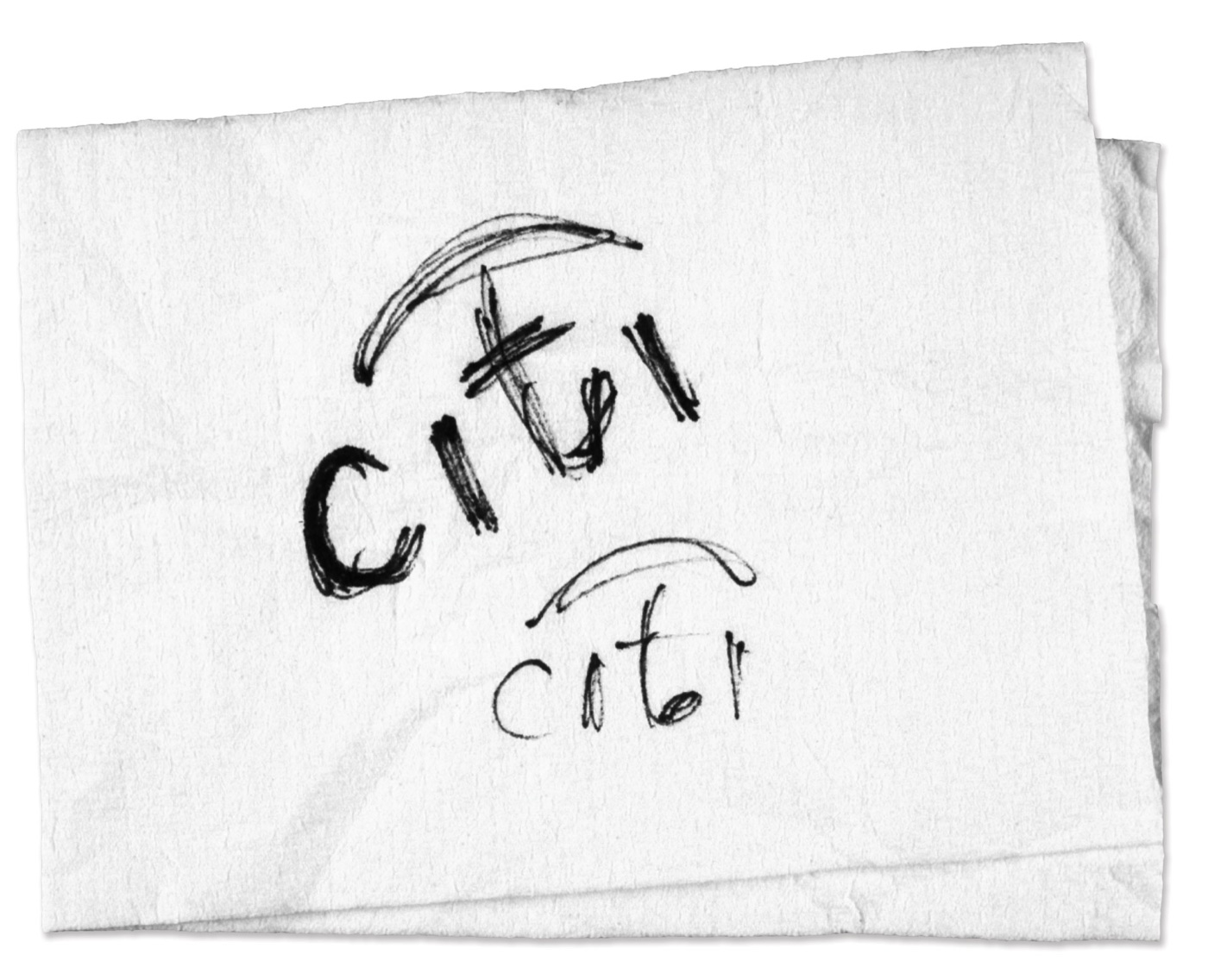
The exact wording depends on who's telling it. The math doesn't. Those 34 years were packed with ideas that went nowhere. Killed concepts. Rejected sketches. Directions she dropped herself. None of them sold.
All of them were in the napkin.
That's what a dead end actually is. Training. You chase an idea to the wall and learn where the edges are, what a brand can't carry, and which choices look great pinned up and fall apart the moment a client says "talk us through it." Do that enough times and the lessons disappear into instinct. Which is convenient, because instinct is the one thing clients will happily pay a premium for and nobody can put in a timesheet.
4. Some ideas aren't dead. They're early.
Here's one most people in advertising know by heart. Apple's "1984", the Ridley Scott spot that launched the Macintosh, didn't start life as a TV commercial at all. According to its history, it grew out of an abandoned print campaign. A dead idea, sitting in a drawer at Chiat/Day.
Then it nearly died a second time. When Apple's board saw the finished ad in December 1983, they hated it, and the agency was asked to sell back the Super Bowl airtime. They resold 30 of the 90 seconds and, by at least one account, never really tried to sell the rest. "1984" aired nationally exactly once, on January 22, 1984. It won the Cannes Grand Prix, and Advertising Age later named it the greatest commercial ever made.
So was it a dead end, or was it just right too soon? How many of the ideas sitting in your old pitch folders are the same thing?
5. Yes, some dead ends are just dead
To be fair to the efficiency crowd, they have a point. Some dead ends are just expensive. Teams can fall in love with exploring and forget they're meant to arrive somewhere, and the deadline has no interest in how fascinating your detour was. "We learned a lot" is not a deliverable.
The answer isn't to explore less. It's to leave on purpose. Know when an idea has taught you what it can, take the lesson, and get out. Drifting out of a dead end with nothing is waste. Walking out with something is the job.
6. Keep your dead ends
So next time an idea dies, don't bin it. Keep the moodboard, the sketches, the half-written line, the deck that never got presented. Before you move on, give it one honest look and ask what it taught you about the idea that survived. Then put it somewhere you'll actually find it again.
Most of it will stay there. Some of it will quietly sharpen your eye for the next pitch. And every so often, one will walk back in years later and turn out to be exactly right. In 2014 Mike Cessario, then working in advertising, pitched canned water to a public-service client as a stunt to poke fun at energy drinks. The client said no. The idea stuck with him anyway, and it became Liquid Death, valued at $1.4 billion in 2024.

Which raises an uncomfortable question for a business that bills by the hour: if the work that didn't sell is where the instinct comes from, what exactly are we writing off?
Sources
- Paula Scher: Pentagram
- Apple, "1984", Chiat/Day, 1984
- "1984" commercial: YouTube
- Liquid Death Big Game commercial: Liquid Death on YouTube
- Liquid Death and Mike Cessario: Fortune, March 2024
Written by Steve Salgado